

Why Your Optometrist Prescribes Your Contact Lens Solution (and Why You Shouldn't Swap It)
Most people treat contact lens solution like shampoo: whatever is on special will do. It won't. Your solution is prescribed by your optometrist, in the same way your lenses are. It is selected to match two things: the material your lens is made of, and the biology of your own eye. It is not something you pick off the shelf because you like the bottle.
Why the solution is part of the prescription
Every lens material behaves differently. Some attract protein, some attract lipid, and each takes up and releases the disinfectant in a solution in its own way. Your eyes differ too: your tear film, how much protein and oil you deposit on a lens, and how your ocular surface tolerates a particular disinfectant. Put the wrong solution with the wrong lens on the wrong eye and you get the complaints we hear every week — lenses that feel dry by mid-afternoon, redness, stinging on insertion, and lenses that never seem to last.
So when we fit your lenses we also choose your solution. If a pharmacy or supermarket swaps you to something else, or you change because of price, you have changed your prescription without anyone checking it. If you want to change, ask us first.
How we choose: it is an algorithm, not a brand preference
There is no single best solution. Our optometrists work through the same steps for every wearer:
- Your lens material. Each family of lens material takes up and releases disinfectant differently, so the material narrows the field first.
- Your eye's biology. Your tear film, how much protein and lipid you deposit, and how your ocular surface tolerates a given disinfectant.
- How you wear your lenses. Daily wear, occasional wear and overnight ortho-K each need a different routine.
- How your eyes respond. If comfort or the lens surface is not right at review, we change the solution.
Steps two to four cannot be done from a web page. If you want to know which solution is best for you, book a contact lens check-up so we can look at your biology and recommend one.
One example: Acuvue lenses
Acuvue lenses from Johnson & Johnson are some of the most widely worn soft lenses, so here is step one worked through. For their etafilcon, galyfilcon and senofilcon materials, our usual starting point is Opti-Free PureMoist.
That is a starting point, not a prescription. It is general information and not medical advice for your eyes. It covers the material only, and your own eye may need something different. If your lenses still feel dry or uncomfortable on it, do not keep switching bottles: dry eye is a common reason, and it needs to be assessed. Book a Dry Eye Evaluation. It's a paid appointment, and the fee is confirmed when you book.
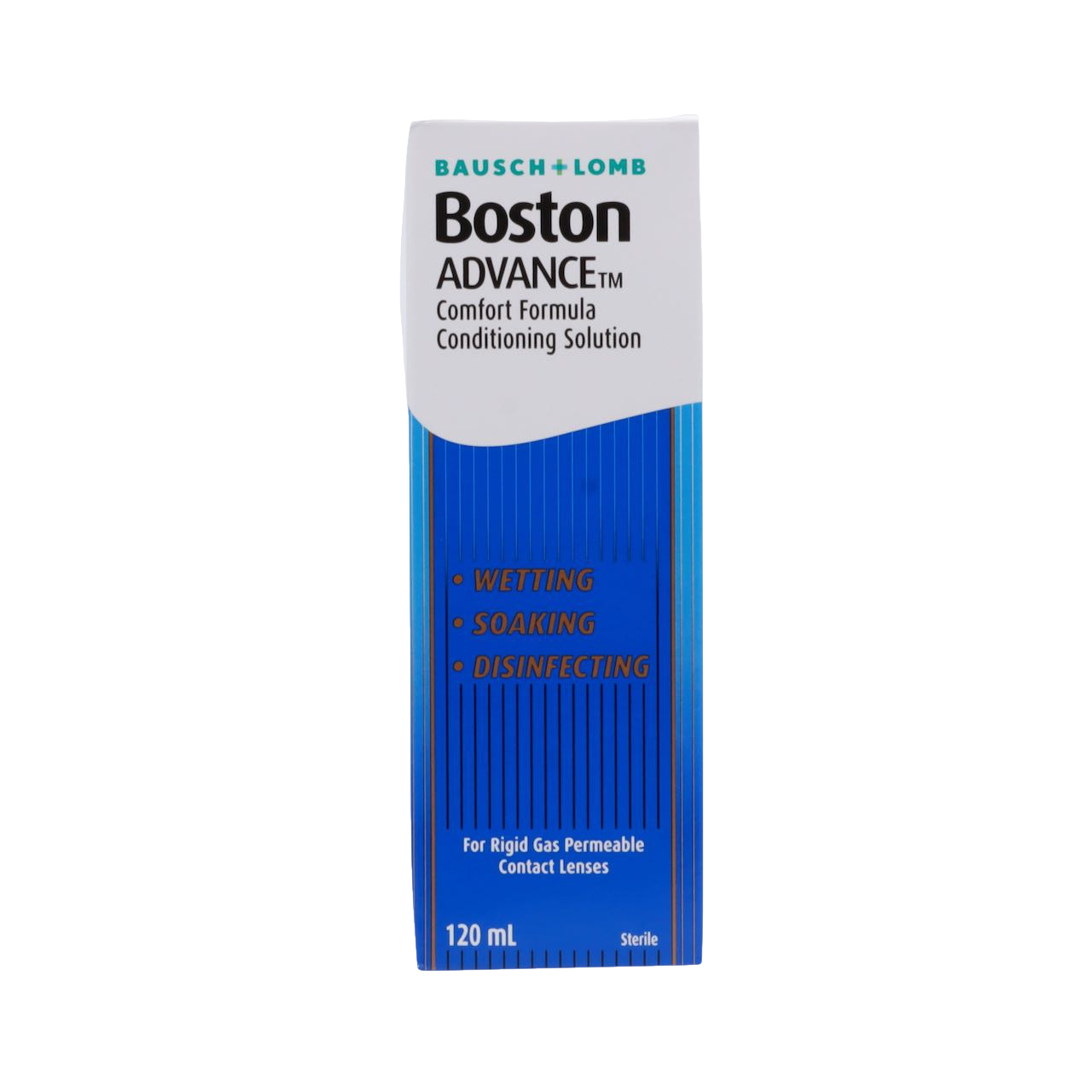
Rigid, ortho-K and scleral lenses follow a different care system altogether. See how to clean ortho-K and RGP lenses.
When we move you to a peroxide system
Multi-purpose solutions contain preservatives, and some eyes react to them. A hydrogen peroxide system disinfects without leaving a preservative on the lens once it has neutralised. Ever Clean Plus is best known for rigid lenses, but we also use it for soft lenses, and AOSept Plus with HydraGlyde is the other peroxide system we prescribe. Peroxide needs correct technique: lenses stay in the supplied case for the full neutralising time, and unneutralised peroxide must never reach the eye. That is another reason it should be prescribed and explained rather than self-selected. You can see the range in our hydrogen peroxide solutions.
The rules that apply to every solution
- Fresh solution every time. Never top up what is already in the case.
- Tap water never touches your lenses or your case.
- Saline rinses. It does not disinfect and it does not store. For rinsing we use preservative-free Eyeye Saline, and Avizor Saline Unidose for filling scleral lenses.
- Replace your lens case every three months.
If your lenses still feel dry
Sometimes the solution is not the problem. Dry eye and blepharitis both make lens wear uncomfortable, and changing bottles will not fix either. If your lenses are comfortable in the morning and miserable by evening, a preservative-free drop that can be used over lenses can help in the meantime — see our preservative-free eye drops — but the cause is worth finding. Book a Dry Eye Evaluation with us in Hamilton. It's a paid appointment, and the fee is confirmed when you book.
Not sure you are on the right solution?
Bring your lenses, your case and the bottle you are using. We fit soft, RGP, ortho-K and scleral lenses every day, and matching the care system to the lens and the eye is part of that work.
→ Book a contact lens appointment or call 07 847 3195.
Rose Optometry has fitted and looked after contact lenses from our Hamilton practice since 1969. The solutions above are in stock and dispatched by us, with free NZ shipping over $100. Browse all contact lens solutions.
This is general information. Always follow the specific care regime your own optometrist prescribed for your lenses, and read the current label.
Related: Choosing the right contact lens solution · Which saline is safe for scleral and rigid lenses · How to clean ortho-K and RGP lenses