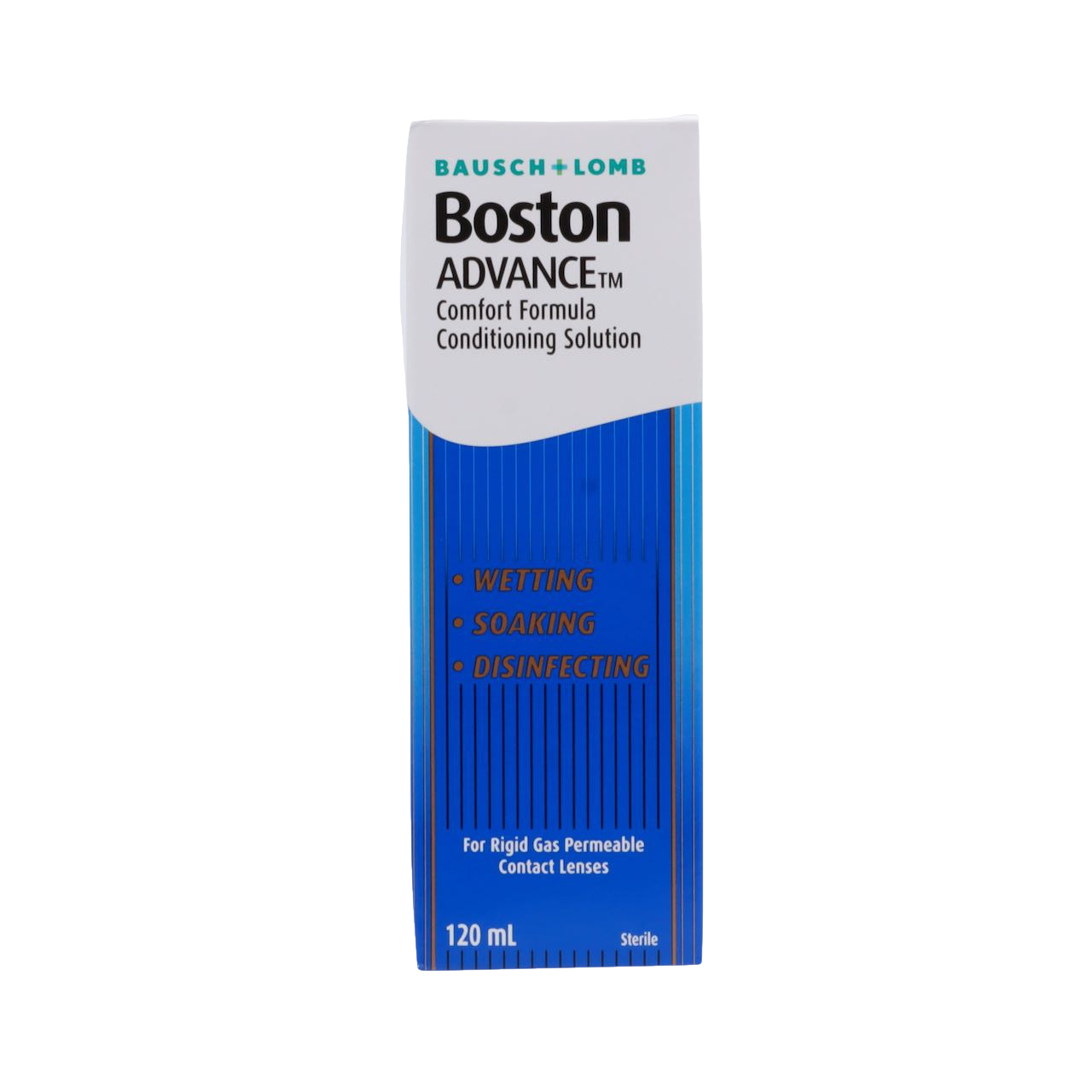

If you wear scleral, orthokeratology or daily-wear rigid gas permeable lenses, the saline you use is not a minor decision — and it is not a place to substitute whatever the pharmacy has on the shelf.
This comes up often enough in our specialty lens clinic that it's worth setting out properly.
Our recommendation
Preserved rinsing salines — including Optesol Saline Solution (Noru Pharma) — are not recommended for use with orthokeratology, scleral, or daily-wear rigid lenses.
This isn't a criticism of the product for the job it's labelled for. Optesol's own label describes it as a rinsing solution, and as a brief rinse for soft lenses that's a reasonable description. Our concern is a different use: filling a scleral lens, or rigid lens wear where the solution stays in prolonged contact with the cornea.
The reason is on the label. Optesol is preserved with polyhexamethylene biguanide (PHMB) 0.0001%, alongside boric acid 0.246%.
Why a preservative changes everything for a scleral lens
With a soft lens, a rinse is exactly that. Most of the solution is gone within a blink or two, and whatever preservative it contained is diluted by your own tears almost immediately.
A scleral lens is a completely different situation. It is filled with fluid before it goes on the eye, and that fluid then sits in a sealed reservoir directly against your cornea for the entire wearing day — routinely twelve hours or more. Nothing flushes it. Nothing dilutes it. Whatever you filled it with is what bathes your cornea until you take the lens out.
Preservatives are designed to kill micro-organisms in a bottle. They are not designed to sit undiluted against corneal epithelium all day. PHMB in particular is well recognised in the contact lens literature as a cause of hypersensitivity and toxic reactions on the ocular surface in susceptible wearers, and the risk rises with contact time and concentration at the surface.
The cornea also has no blood supply. It takes its oxygen and much of its protection from the tear film — and under a sealed scleral lens, that tear film is your filling solution.
The same logic applies, less dramatically, to ortho-K and daily-wear RGP lenses: a rigid lens traps a thin layer of whatever it was rinsed or inserted with directly against the central cornea, and it stays there.
What to look for on any label
Read the preservative line. If a saline lists PHMB, polyquaternium, benzalkonium chloride, chlorhexidine, thiomersal or any other preservative, it does not belong in a scleral reservoir. "Sterile" and "preservative-free" are not the same claim.
Be wary of large bottles. A 500ml bottle is a giveaway that a product is designed for volume rinsing rather than for filling a lens. Large multi-dose bottles need preservative precisely because they're open for months — Optesol's own instruction is to discard 90 days after opening.
"For soft and hard contact lenses" is not the same as "for scleral lenses." Labelling that covers rinsing does not extend to prolonged corneal contact.
What we recommend instead
These are the three we dispense, and the three we'd hand you across the counter:
- Avizor Preservative-Free Saline Unidose — single-use vials, no preservative at all. This is our first choice for filling a scleral lens. One vial, one application, nothing left over to become contaminated, and nothing in it that shouldn't sit on a cornea all day.
- Eyeye Preservative-Free Saline 355ml — preservative-free in a larger bottle, better value if you're using volume. Observe the discard-after-opening period on the label; preservative-free means exactly that, so an opened bottle has a limited safe life.
- Splash Saline — a straightforward rinsing saline for RGP and ortho-K lenses.
The full range is in Scleral & Specialty Lens Care NZ and RGP & Ortho-K Lens Care NZ.
Three more rules worth committing to memory
Saline rinses. It does not disinfect. Storing lenses in saline overnight is not disinfection — that's a separate solution and a separate step. This mix-up is common and it carries the most serious consequences.
Never use tap water — on the lens, in the case, or to rinse either. New Zealand tap water is safe to drink and is not sterile; it can carry Acanthamoeba, which causes a rare but sight-threatening corneal infection. Rigid and scleral lens wearers are over-represented in the case reports precisely because rinsing under the tap feels so natural.
Contact lens saline, nasal saline, wound-irrigation saline and piercing saline are not interchangeable, whatever the label says about sodium chloride concentration. What differs is the buffering and the additives, and those are exactly what your cornea will notice.
If something doesn't feel right
A properly matched filling solution should be unremarkable. Stinging on insertion, redness that builds through the day, or vision that fogs earlier than usual is information — not something to push through.
Take the lens out. Don't put it back in until you've been seen, and keep the bottle so we can look at what's in it.
If your eye is red, painful, light-sensitive, or your vision has dropped, that's a same-day problem rather than a next-week one. Ring us on 07 847 3195.
And if you simply aren't sure whether what you're using is right, bring it in. It takes thirty seconds to read a label, and it's a far cheaper conversation than treating a corneal abrasion.
Rose Optometry fits and looks after scleral, RGP and ortho-K lenses from our Hamilton practice, and has done since 1969. Everything above is in stock and dispatched by us, with free NZ shipping over $100.
Written by Jagrut Lallu — BOptom (Hons), MSc Specialty Lenses (Hons), FIAOMC. Therapeutic Optometrist & Contact Lens Specialist. Founder, New Zealand Eye Research Centre; Partner, Rose Optometry; WCO Asia-Pacific Myopia Ambassador; International Myopia Institute NZ Ambassador; Clinical Senior Lecturer, Deakin School of Optometry; Honorary Teaching Fellow, University of Auckland.
This is our clinical recommendation based on published product composition and our experience fitting specialty lenses. Product formulations can change — always read the current label. Always follow the specific care regime your own optometrist prescribed for your lenses.
Related: How to clean ortho-K and RGP lenses properly · Keratoconus in New Zealand