

TheraTears
TheraTears EXTRA Dry Eye Hydration Preservative-Free Eye Drops 10ml (Hyaluronate 0.3%)
TheraTears EXTRA Dry Eye Hydration Preservative-Free Eye Drops 10ml (Hyaluronate 0.3%)
✔ Stock on hand — ships NZ-wide from Rose Optometry, Hamilton.
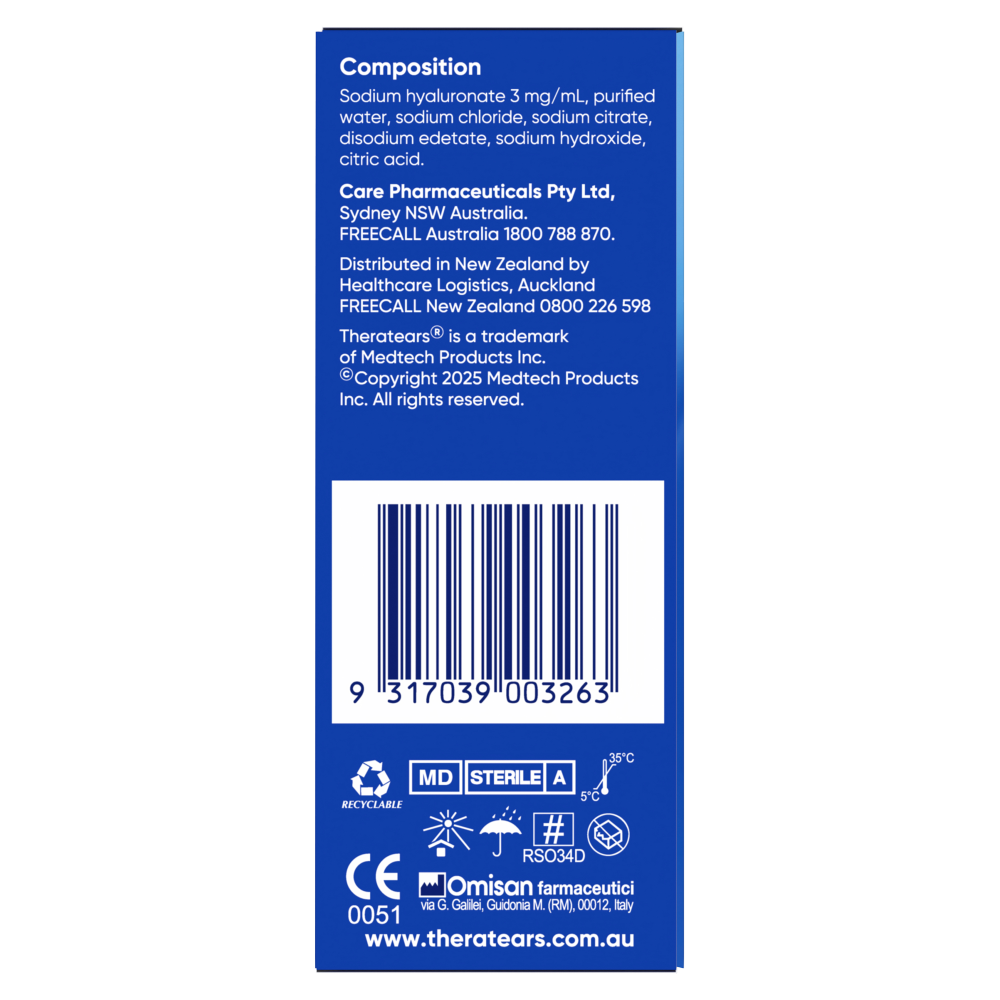
TheraTears EXTRA Dry Eye Hydration is the stronger of the two new TheraTears drops: sodium hyaluronate 3 mg/mL (0.3%), preservative-free, in a 10 mL multi-dose bottle, $38.10. It replaces the TheraTears night-time gel we used to stock — a heavier, longer-lasting drop for eyes that are dry most of the day, without the blur of a gel.
What it is
- Active: sodium hyaluronate (hyaluronic acid) 3 mg/mL — three times the concentration of TheraTears Dry Eye Hydration.
- Preservative-free multi-dose bottle, 10 mL. Use within 180 days of first opening.
- Contact lens compatible: the label allows 1–2 drops directly onto the lens, before or after insertion.
- Indicated on the label for dry, dehydrated, irritated, reddened and tired eyes; suitable for sensitive eyes.
- Made in Italy for Care Pharmaceuticals (Sydney); distributed in New Zealand by Healthcare Logistics. Sterile medical device.
Who it's for
- Persistent, all-day dryness — the person who used to need a gel at night but hated the blur.
- Eyes that are gritty by late afternoon on a 0.1% drop.
- Contact lens wearers with longer wearing days, including scleral and ortho-k wearers who need a drop that can go in over the lens.
- Anyone who has been told to stop using preserved drops, or who uses drops many times a day.
- For occasional, mild dryness the lighter TheraTears Dry Eye Hydration is usually enough.
How to use
- Wash and dry your hands.
- Instil 1–2 drops in each eye, 1–5 times daily, or as directed by your optometrist.
- Contact lens wearers: 1–2 drops directly onto the lens, before or after insertion.
- Don't touch the dropper tip to the eye or any surface. Store between 5°C and 35°C. Discard 180 days after opening.
Not for children under 1 year. Children's drops must be given by an adult. If you are pregnant, breastfeeding or have a medical condition, check with your optometrist or doctor first. If irritation persists, stop and get your eyes looked at.
The honest caveat
A 0.3% hyaluronate is thicker and stays on the eye surface longer than a 0.1% drop — tear-film imaging studies show the extra volume persisting for around ten minutes rather than three. Head-to-head trials have not shown a clear difference in symptoms between the two strengths, though, so think of this as a longer-lasting feel per dose rather than a stronger medicine. It still only replaces the watery layer of the tear film. In clinic studies most people with dry eye show signs of meibomian gland dysfunction — the eyelid oil glands under-deliver and tears evaporate too fast — and that needs treating at the lids, not with ever-stronger drops. If you need this bottle several times a day, every day, the next step is a full eye examination (with us, or a copy of one done elsewhere in the last six months) followed by a Dry Eye Evaluation, where we measure the tear film and find the cause. It's a paid appointment; the fee is confirmed when you book.
Questions we get asked
Is this a gel? Does it replace TheraTears Gel?
It replaces the gel in our range, but it is a drop, not a gel. It is thicker than the 0.1% version and lasts longer, with far less blur than a true gel. If you genuinely need something to hold your eyes through the night, a gel or ointment is still the right tool — ask us. What changed and why is in TheraTears in NZ has changed.
0.3% versus 0.1% — which should I buy?
Start with 0.1% for occasional dryness and 0.3% for dryness that is there most of the day or by the end of it. If neither keeps you comfortable, that is a sign to be assessed, not to buy a third bottle. We lay the whole range out by strength and chemistry in the Rose Optometry dry eye drop formulary, and what the percentages actually change in sodium hyaluronate eye drops explained.
Can I use it with contact lenses in?
Yes — the label allows 1–2 drops directly onto the lens, before or after insertion. It suits scleral and ortho-k wearers who want a thicker drop that is still lens-safe. See eye drops for contact lens wearers.
How does it compare with Hylo-Forte?
Hylo-Forte is a 0.2% preservative-free hyaluronate in the COMOD pump bottle; TheraTears EXTRA is 0.3%, the same strength as Lacrifresh Ocu-Dry 0.30%. They are close relatives — the differences are the strength, the bottle system and the other ingredients — and people often simply prefer the feel of one over another. If one isn't holding you, try the other before concluding that drops don't work.
Why preservative-free?
Preservatives keep a bottle sterile; they do nothing for your eye. Benzalkonium chloride, the commonest one, can damage the surface cells of the eye with frequent or long-term use, and a soft lens can soak it up and release it slowly. That is why preservative-free is the standard advice for moderate to severe dry eye, for anyone using drops many times a day, and generally for contact lens wearers. More in preservative-free eye drops: why they matter and the preservative-free range.
Why buy from Rose Optometry
- Independent, optometrist-owned New Zealand practice — Hamilton since 1969.
- Free optometrist advice with every order: reply to your order email and a clinician answers.
- Free NZ shipping on orders over $100, sent from Hamilton.
Couldn't load pickup availability