

TheraTears
TheraTears Dry Eye Hydration Preservative-Free Eye Drops 10ml (Cross-Linked Hyaluronate 0.1%)
TheraTears Dry Eye Hydration Preservative-Free Eye Drops 10ml (Cross-Linked Hyaluronate 0.1%)
✔ Stock on hand — ships NZ-wide from Rose Optometry, Hamilton.
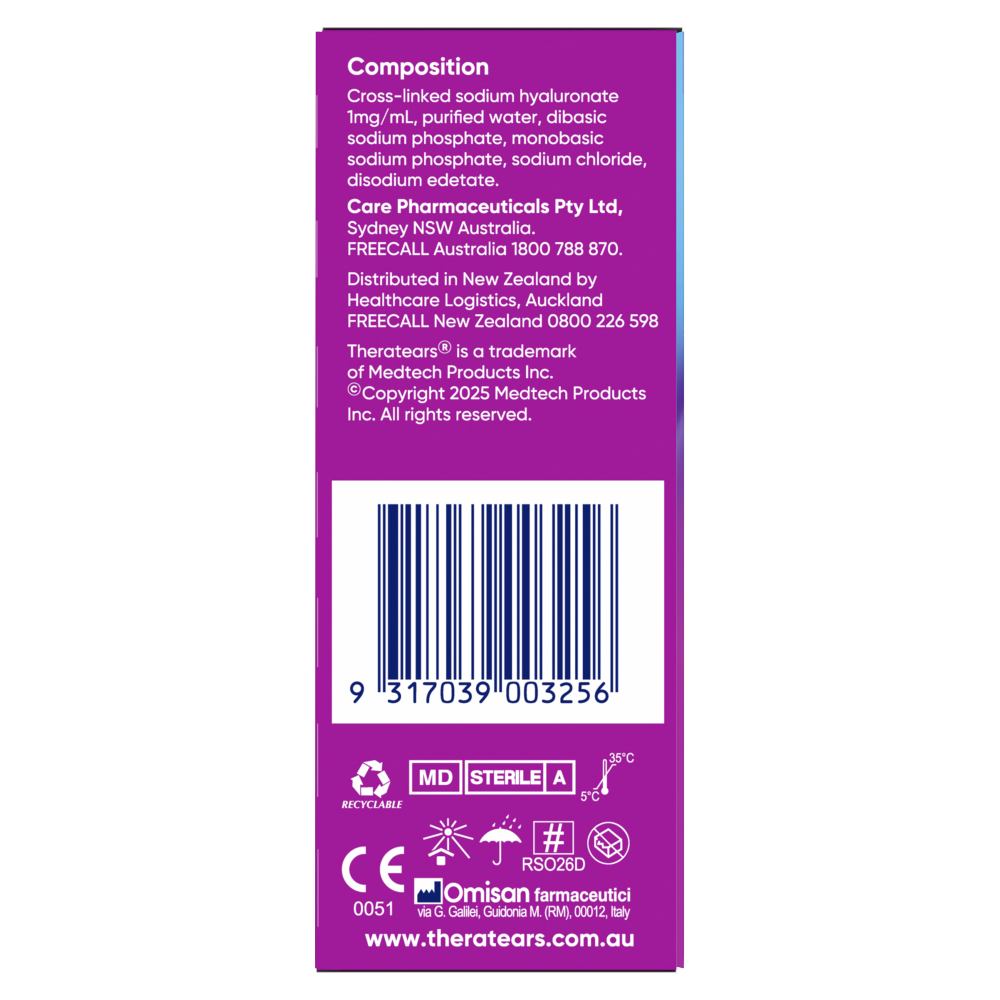
TheraTears Dry Eye Hydration is the new preservative-free TheraTears for everyday dry eye: cross-linked sodium hyaluronate 1 mg/mL in a 10 mL multi-dose bottle, $34.50. It replaces the old TheraTears single-use vials ("TheraTears Drops") that we used to stock. One bottle, no preservative, and it can go in over any contact lens.
What it is
- Active: cross-linked sodium hyaluronate (hyaluronic acid) 1 mg/mL — the 0.1% strength.
- Preservative-free multi-dose bottle, 10 mL. Use within 180 days of first opening.
- Contact lens compatible: the label allows 1–2 drops directly onto the lens, before or after insertion — soft, rigid, ortho-k and scleral.
- Indicated on the label for dry, dehydrated, irritated, reddened and tired eyes; suitable for sensitive eyes.
- Made in Italy for Care Pharmaceuticals (Sydney); distributed in New Zealand by Healthcare Logistics. Sterile medical device.
Who it's for
- Mild to moderate dryness from screens, air conditioning, wind, flying and long days.
- Anyone using drops several times a day, every day — the people for whom a preserved bottle stops being a good idea.
- Contact lens wearers who want one drop that is safe with the lens in.
- People whose eyes sting or redden with preserved drops.
- If your eyes are dry most of the day, or still gritty at bedtime, look at TheraTears EXTRA (0.3% hyaluronate) instead — it is the heavier of the two.
How to use
- Wash and dry your hands.
- Instil 1–2 drops in each eye, 1–5 times daily, or as directed by your optometrist.
- Contact lens wearers: 1–2 drops directly onto the lens, before or after insertion.
- Don't touch the dropper tip to the eye or any surface. Store between 5°C and 35°C. Discard 180 days after opening.
Not for children under 1 year. Children's drops must be given by an adult. If you are pregnant, breastfeeding or have a medical condition, check with your optometrist or doctor first. If irritation persists, stop and get your eyes looked at.
The honest caveat
A lubricant replaces the watery part of your tears and makes the surface more comfortable. It does not fix the reason the tears are failing. In clinic studies most people with dry eye show signs of meibomian gland dysfunction — the eyelid oil glands under-deliver, so tears evaporate too fast — and no drop corrects that on its own. If you are reaching for drops several times a day and still uncomfortable, the drop isn't the problem; the diagnosis is. A full eye examination comes first (with us, or a copy of one done elsewhere in the last six months), and then a Dry Eye Evaluation works out which layer of the tear film is failing and what actually treats it. It's a paid appointment; the fee is confirmed when you book.
Questions we get asked
Is this the same as the old TheraTears drops?
No. The old TheraTears vials were a carmellose (CMC) hypotonic, electrolyte-balanced tear. The new TheraTears range is built on sodium hyaluronate instead, in a preservative-free multi-dose bottle. The "day and night" pairing has gone: this bottle is the everyday drop and TheraTears EXTRA is the stronger one. The full story is in TheraTears in NZ has changed.
What does "cross-linked" hyaluronate mean?
Ordinary hyaluronate is a long chain of sugar molecules that holds water. Cross-linking ties those chains to one another so the drop holds its structure and is designed to stay on the surface of the eye for longer at the same concentration. Laboratory and animal studies support the longer retention; trials comparing cross-linked hyaluronate on its own against standard hyaluronate in people have not yet been published, so we describe it as a sensible everyday hyaluronate drop rather than a proven upgrade. Hyaluronate drops as a class have been shown in trials to improve dry eye symptoms and some signs compared with plain saline. More in sodium hyaluronate eye drops explained.
Can I use it with contact lenses in?
Yes — the label specifically allows it, before or after insertion. If a drop only buys you a few minutes of comfort in your lenses, the lens and its fit need reviewing rather than the drop. Our article on eye drops for contact lens wearers covers which drops can and can't go in over a lens.
Will it blur my vision?
Briefly, if at all. It is a drop, not a gel. For something that stays put overnight, you want a gel or ointment, and those genuinely do blur.
Why preservative-free?
Preservatives are there to keep a bottle sterile, not to help your eye. Benzalkonium chloride, the commonest one, can damage the surface cells of the eye with frequent or long-term use, and a soft contact lens can soak it up and release it slowly. That is why preservative-free is the standard advice for moderate to severe dry eye, for anyone using drops many times a day, and generally for contact lens wearers. We explain this properly in preservative-free eye drops: why they matter, and you can browse the whole preservative-free range.
How does it compare with Hylo-Fresh?
Hylo-Fresh is also a 0.1% preservative-free hyaluronate; TheraTears uses the cross-linked form. Both are sensible everyday drops. We compare the whole shelf, by chemistry, in the Rose Optometry dry eye drop formulary.
Why buy from Rose Optometry
- Independent, optometrist-owned New Zealand practice — Hamilton since 1969.
- Free optometrist advice with every order: reply to your order email and a clinician answers.
- Free NZ shipping on orders over $100, sent from Hamilton.
Couldn't load pickup availability